
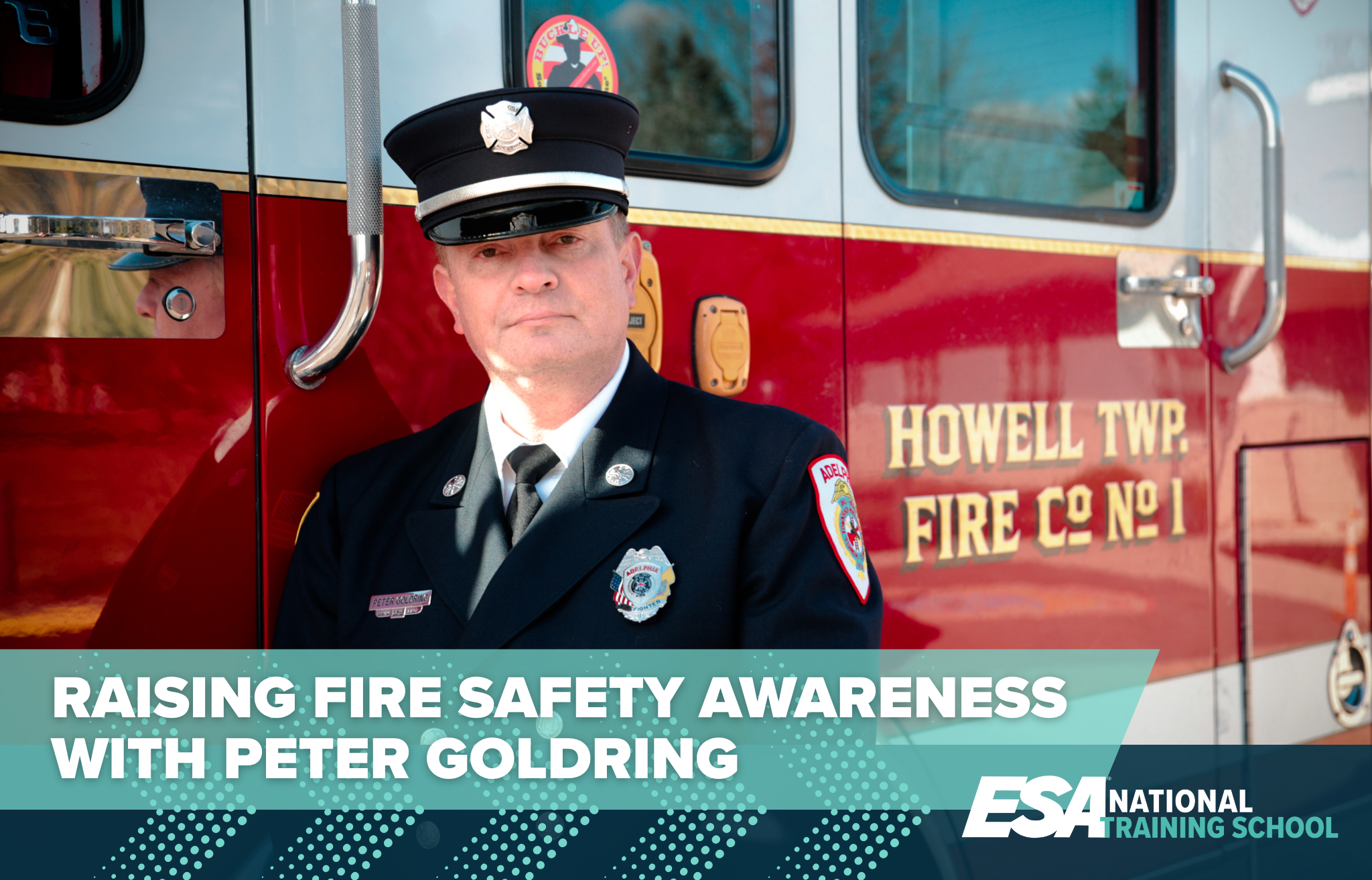
Raising Fire Safety Awareness with Peter Goldring
In 1922, the first full week of October was established as National Fire Safety and Prevention Week in commemoration of the 1871 Chicago Fire. Since then, the whole month of October has grown to be recognized as National Fire Prevention Month.
To raise awareness of the importance of fire prevention and safety, ESA met with Peter Goldring, a lifetime fire professional and leading expert in the industry.
Meet Peter Goldring, a Lifelong Fire Safety Expert and Volunteer Firefighter
Born into an industry family that sold, installed, monitored, and maintained fire alarm systems in the Northeast, Goldring started helping in the family business as a child, following people around the office and going on service calls, learning to install and monitor systems. Today, Goldring serves the industry as President of Goldring Protection, an ESA National Training School and NICET-certified fire technician elected fire commissioner in Howell Township, New Jersey, and volunteer fire fighter, and can speak to fire safety at various levels.
According to Goldring, “Fire Prevention Month is a chance to educate kids, young adults, adults, and seniors and hopefully recruit some new volunteer members. [At our fire station], we always have an open house in October and let people come learn about the volunteer service and see and touch the fire trucks.” With fire safety an ever-growing concern, it’s important that people know that volunteers make up 74% of the nation’s Fire Service. Fire Prevention Month provides a national opportunity for everyone in the industry to pull together to increase awareness, using anything from snail mail, email newsletters, social media posts, informational releases– anything that informs people how they can be making their homes and businesses safer and what to do in the event of a fire.
What Are Some of the Biggest Misconceptions Surrounding Fire Safety?
“There’s always been this idea of ‘Oh, the fire inspector is a bad guy, or the fire marshal is a bad guy,’” Goldring answers. “But the way I see it is that the inspector is requiring things that make you, your family, and your business safer.”
NFPA standards dictate how systems are designed and monitored, how fire trucks are staffed, and how fire command is run. All of these standards are vital for improving fire detection and shortening fire response time. Goldring shared with us that the importance of faster fire response time has drastically increased due to new building materials, including synthetic fabrics and plastics of modern furniture and appliances, and electric cars which can lead to electrical fires. Not only do all of these components burn faster, but they release toxic fumes. Instead of seeing inspectors as the bad guys, Goldring argues that there’s a reason behind inspectors and their rules, and businesses and individuals should jump at any opportunity to minimize their fire risk.
What Are Some New Technologies Improving Fire Prevention and Detection?
Fortunately, while fire risks have grown, fire response technologies have improved. Goldring explains that while video is playing an increasingly big role in fire detection, the most exciting evolutions revolve around fire response, with companies like Rapid SOS at the forefront. Rapid SOS on a commercial fire alarm has the ability to take panel data from the subscriber’s premises and, within seconds, send an automated dispatch to the fire agency and get it to first responders while monitoring centers notify an end users. In addition to This allows much quicker response times responding agencies have access to vital information.once a fire has been detected.
Smart technologies are becoming bigger players as well in fire detection and prevention. “While a lot of the iceberg is still underwater,” Goldring says. “There are some exciting new products already out there.” He shares one such product that he uses in his home, a little device called TING that plugs into an outlet and detects spikes, arcs, or any other possible precursors to electrical fires. Connected to both the house’s electrical circuits and to the web, TING can pick up on early warning signs before smoke and carbon monoxide detectors.
Even with evolving technologies, Goldring thinks there’s still a lot of untapped potential. For example, imagine a fire alarm goes off in your house right now. Central station sends the fire trucks and notifies the contacts, but otherwise, there’s not much to do. Hopefully, we’ll start to see a lot more holistic integration soon, such as interconnected alarm systems and integrations with other equipment. For example, once the alarm goes off, the system shuts down air conditioner fans to prevent the smoke’s spread. The garage doors open and doors unlock throughout the house, and the lights all turn on automatically. All of this provides any occupants a higher chance of getting out before things escalate. Additionally, it simplifies the first responders’ job once they arrive. “These are readily accessible, available things that many people don’t think about right now that they could be implementing,” Goldring encourages.
How Can We Educate Clients on Their Responsibilities When It Comes to Fire Safety?
“It’s never pleasant to sell fear,” Goldring says with a smile. “In the beginnings of our industry, it’s how we had to sell. It’s always a challenge to convince a homeowner, business owner, or end user of any kind to spend any given amount of money on a ‘what if.’ So, it becomes necessary to communicate the risks of not doing so.”
Goldring explains that it’s crucial to explain the heightened risks of fire in today’s modern world. Industry professionals can share with their clients what Goldring shared regarding the high flammability of most modern materials. Ask clients what their houses and furniture are made of. Compare that to what they may have grown up around. Center your conversation around the changes in today’s environment and how it’s crucial to minimize and detect risk where it exists to avoid losses.
What Are Some of the Biggest Challenges or Opportunities in the Fire Safety Industry Today?
“I think the biggest opportunity lies in embracing your code officials and embracing fire prevention,” Goldring states. “Don’t fight the standards. They’re there for a reason. Learn how to help people comply with them. Have good brands of equipment available and build a profit center, ensuring you can grow your business and develop new channels. Fire safety is a very stable, secure market, since DIY doesn’t really present a threat to it.”
A Teaser on ESX 2026’s Educational Fire Safety Track
“The Electronic Security Association has made it very clear that they look at the Fire Prevention and Safety Industry as an underrepresented area,” Goldring says. ESA is working hard to tailor training to fire safety installers, technicians, providers, and integrators at next year’s ESX. Goldring, an ESX education advisor, hopes to see a growing number of vendors and manufacturers in the fire industry each year at ESX.
We’ll be meeting again with Peter Goldring in the upcoming months as educational sessions are ironed out for ESX 2026 in Irving, Texas.
“We’ll have a little something for everybody,” Goldring explains eagerly.“We want to have programming for everyone from the seasoned veteran to those barely getting started that don’t know where to start.”
Goldring says educational programming next year will hopefully include more information about local standards, licensing, and requirements.
ESA National Training School Course Sale for National Fire Prevention Month
To honor the service of industry heroes like Peter Goldring and to raise awareness for National Fire Prevention Month, ESA’s National Training School fire courses will be on sale through the month of October. Learn more here.